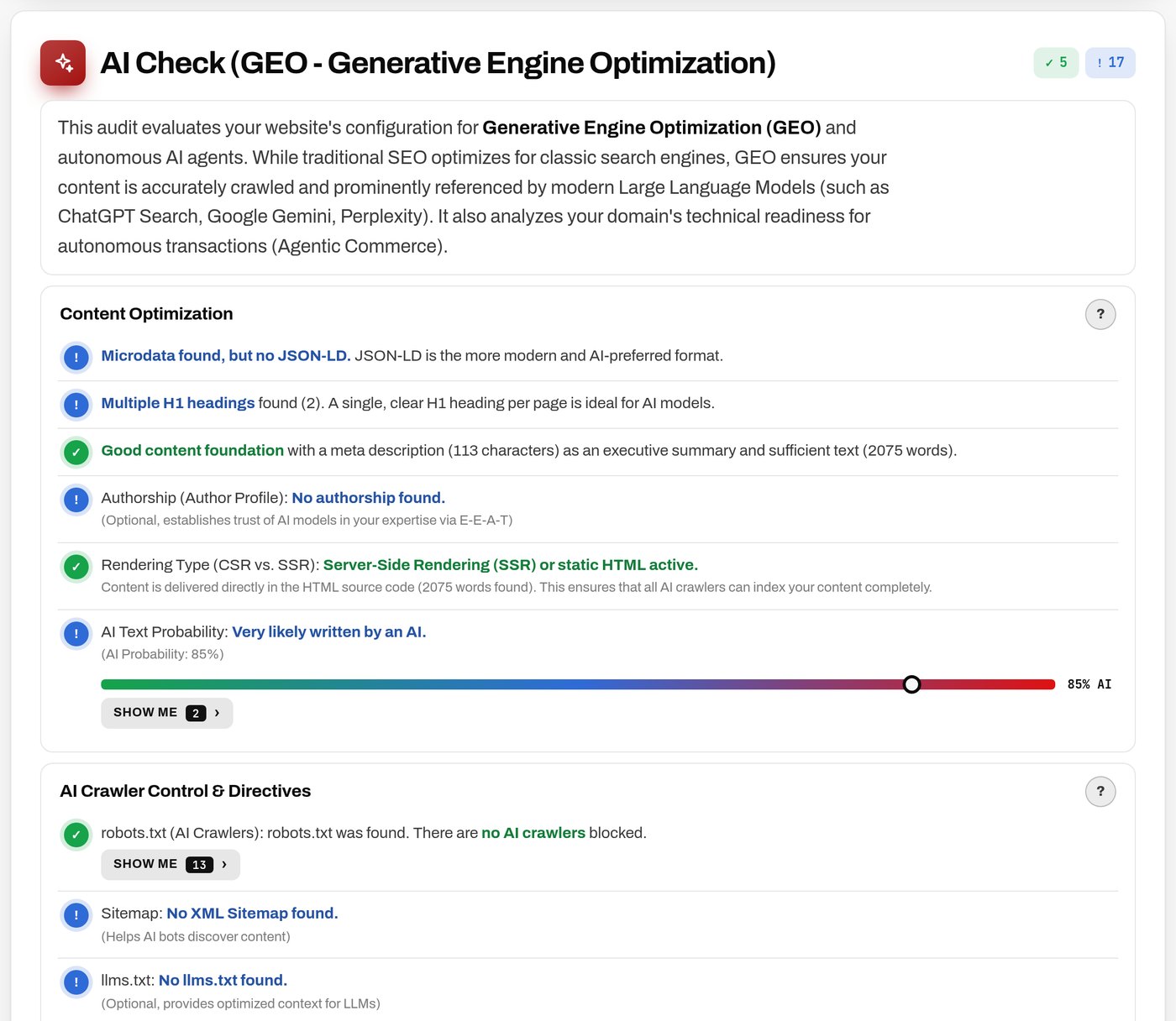
AI Text Probability
SEORCH automatically analyzes the main content of your page and estimates how likely it is that your text was written by an AI.
New 22 AI & GEO checks on board
Test your website for free – Page Speed, Core Web Vitals, OnPage, Offpage and Mobile Friendly in one run.
also available as SEO API or Whitelabel SEO Tool
Then feel free to get in touch with One Beyond Search.
SEORCH automatically analyzes the main content of your page and estimates how likely it is that your text was written by an AI.
Checks whether your website locks out AI search engine crawlers (such as GPTBot, ClaudeBot etc.), either through your robots.txt or through server-side CDN or hosting blocks you may not know about.
Real-time query of the Common Crawl databases to check whether your website is included in the offline training data of AI models.
SEORCH now automatically detects all AI e-commerce interfaces (such as shopping carts, checkouts and catalogs).
A total of 22 new checks have been added. Click here for a full overview with all the details!
Compliance with search engine guidelines is an important factor in SEO success and therefore the ranking of a website. The SEO Check checks your website and shows you errors and problems that prevent a good ranking. Search engines like Google now use several hundred ranking signals to evaluate a website. However, various technical SEO factors must be error-free for a URL to even have a chance of a good ranking.
The SEORCH SEO Check is free and checks more factors than any other SEO checker. You can analyze your site, then make improvements and just do an SEO analysis again. Each URL can be checked any number of times. You can simply create a PDF from the finished analysis or save the URL of your personal SEO check to work with it later.

The SEORCH SEO check checks all important components of search engine optimization. This includes, among other things, whether your website meets the Google quality guidelines. You can only get a good ranking if important parts of your website are accessible and readable by search engines. Currently there are well over a hundred factors from different areas, how fast is your site, can texts, images and links be crawled, do you use semantic HTML tags, does your website also work on mobile phones and tablets, is there duplicate content, etc.
Excerpt of the SEO Check:
Even professionals sometimes forget relevant SEO optimizations. SEORCH was created precisely for this reason. A quick and complete SEO check to make sure everything is fine with the website and there are no SEO errors preventing ranking.
Even though search engines like Google try to crawl and analyze every website properly, it's not as easy as it might sound.
A URL that should rank for a search term in Google must be accessible, it should load quickly and include a reasonable amount of text, images, lists, and tables (where appropriate).
This can all be checked by yourself or with an SEO checker. However, most SEO tools check other factors that are not obvious to a normal user. If, for example, a URL is blocked in robots.txt or if it has a "noindex" tag, it cannot be found using a search engine.
If the content of the URL is repeated or if the page takes a long time to load, ranking is possible, but it will be difficult to appear in the top 10 search results. If a page isn't optimized for mobile and tablet, the page may rank decently on desktop but not show up in a mobile search.
So an SEO checker can help you uncover and fix all of these problems.

This table should primarily give you SEO tips and show you how to get started with search engine optimization before you spend a lot of money on an SEO tool. First try to understand why, which SEO factor needs to be optimized. If you are thinking about booking an SEO tool, first log in to the Google Search Console. This tool is provided by Google free of charge for every website operator and can help you to optimize your website.
| SEO check | Target | Priority |
|---|---|---|
| Mobile | Is there a mobile version of the website, is the site responsive? | high |
| Page Speed | The loading time is less than 3 seconds on average. (Full stack, test multiple pages) | high |
| Core Web Vitals | The Core Web Vitals: Largest Contentful Paint (LCP), First Input Delay (FID), Cumulative Layout Shift (CLS) are complied with | high |
| Title Tags | All title tags are unique, have the right length and match the content of the page (SERP snippet design) | high |
| Meta Descriptions | All meta descriptions are unique, have the right length, fit the content of the page, represent USPs and have CTA (SERP Snippet Design) | high |
| Headlines (H tags) | Present, correct hierarchy, keywords are used in headings | medium |
| HTML Validity | No (few), non-critical errors | medium |
| HTML content | Clean HTML, few external JavaScript and CSS resources, few inline JS and CSS, few third party scripts | medium |
| robots.txt | Is valid. SEO content is accessible. Images, CSS and JS are not blocked. | high |
| Nofollow links | A good page structure does not need nofollow links or they are used sensibly. | low |
| Canonical tags | Use sparingly where necessary, where there is a risk of duplicate content, important pages must have a correct canonical tag. | medium |
| Hreflang Tags / i18n | Deployment required? Technically correct implementation. | medium |
| URL parameters | No URL parameters, if so, then with canonical tag | medium |
| XML Sitemap | All existing SEO relevant pages are included and submitted to the Google Search Console | medium |
| Redirect chains | There are no redirect chains | medium |
| HTTP 404 status code | No internally linked 404 pages | medium |
| HTTP 301 or HTTP 302 Status Codes | No internally linked 301/302 redirects | medium |
| Bot Crawler Ability (Crawlability) | An SEO crawler comes completely through the page and records the number of pages that Google knows or reports in the Search Console. | high |
| URL Structure | URL structure that is comprehensible for users, easy to read and logically structured according to the navigation | medium |
| Directory levels | As much as necessary and as little as possible (3-4 levels are good) | low |
| Duplicate Content (Text) | No internal and no external duplicate content | high |
| Duplicate Content (technical) | Make content accessible only under one domain. Delivery of the page with/without www. Using http / https. Both methods only via 301 redirect | high |
| Text quality, text length | High quality texts, semantics, tables, videos, graphics related to the main keyword of the page | high |
| Keywords | Correct keyword signals to Google? No good ranking without a concrete signal. | high |
| Rich Snippets / Structured Data | Use when it makes sense to use it | medium |
| Navigation | Navigation accessible to Googlebot, understandable to the user, use of NAV tags. | high |
| Breadcrumb | Breadcrumb available, enriched with structured data | low |
| Internal link | SEO relevant pages need to get the most links, linking with varying keywords | high |
| External link | Ideally, the external links point to high-quality, topic-related pages | low |
In order to optimize your website and thus achieve better ranking results, you usually do not need expensive SEO tools. The free SEO tools now provide a wide range of functions. As mentioned above, you should first log into the Google Search Console. Once you have understood the results displayed in the Search Console and corrected them if necessary, you need to think about which keywords you want to rank for. An SEO tool such as SEORCH Ultrasuggest is suitable for this. To check more than one site at a time there is SEO Crawler, it shows you all the technical problems and errors that a search engine can have with your site. To write good text, you need to think about what your audience expects from your content. Always design and write your content for users, ideally better than your competitors and add images, videos, tables and lists to the text. The Content Briefing Tool can help you with this.
After you have put a lot of work into your site, you can also monitor the rankings of the search results. Search engines make frequent updates and rankings can fluctuate accordingly. I use the Keyword Monitor to monitor the ranking of a domain and its keywords.


Necessary SEO Tools:
Optional SEO Tools:
An SEO check is a tool that checks your website for technical errors or problems with search engine optimization. These tools act like a search engine when fetching the page. As a result, they create a list of all tested SEO factors and show where pages need to be optimized.
With a good SEO check you can see at a glance whether a search engine can easily index all the content on the page. The check is a quality assurance for publishers, bloggers and a standard in online marketing.
An SEO Check is software that behaves like the Google Crawler / Google Bot. The software tries to imitate Google's behavior and also makes all problems that can arise visible to the user.
There are so-called SEO crawlers for this. These follow links within pages and thus crawl through a website. The results are far more comprehensive than with a normal SEO check, since a large number of pages usually have to be analyzed.
That depends on your level of knowledge of HTML and web technologies. Many errors and problems can usually be fixed in the blog software, the shop or the CMS itself. In addition, you can contact a web developer and ask them to fix the errors.
When technical tests are represented in just one number, it is possible to get a high score but still have serious errors on the website. It is safer and ultimately better to look at all errors in detail.
Ideally, you have a website that you want to optimize. You think about which keywords you want to rank for and start to integrate a good, high-quality and extensive text on your site. Use an SEO check to find errors and try to fix the errors. It's not easy at first, but over time you'll understand more and get better at SEO.
Technical search engine optimization ensures that a page can be crawled quickly, that all important meta information is available and that there is nothing standing in the way of the success of content SEO. Content SEO affects everything a user can see or read on a website, i.e. text, images, videos, etc.